Skip to content
Wellness Reporting Suitepowered by OLS
Menu

Antimicrobial stewardship, on every report

Your panel already found it.
This is the part that treats it.

Your PCR result arrives with the treatment plan already worked out: dosed, safety-screened, built on published clinical guidance. Molecular and microbiology, cleared by OLS review before it reaches you.

  • DosedDrug, route and duration on every option
  • Safety-screenedSix checks, printed on the page
  • Evidence-basedPublished FDA, CDC, NIH and IDSA guidance
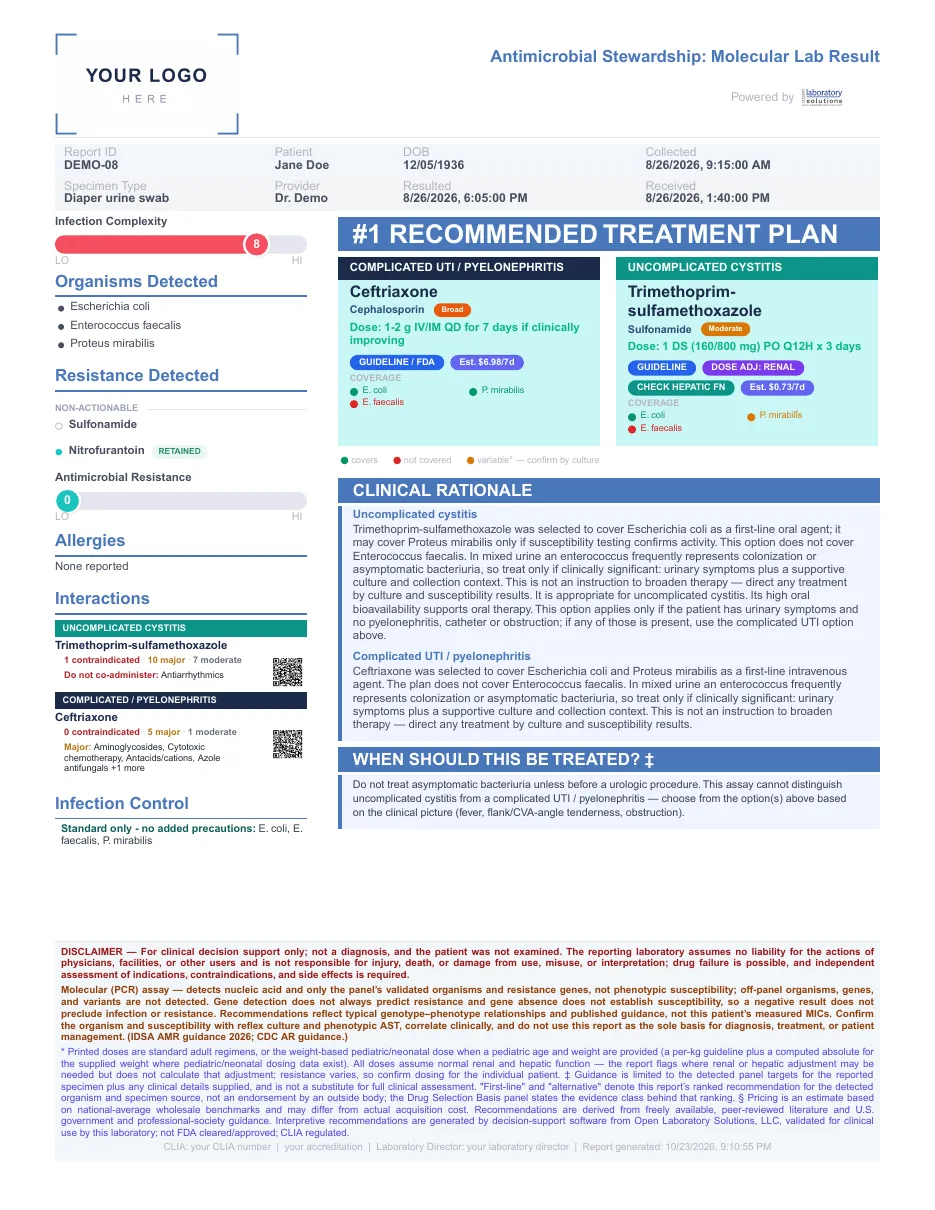
Page one of a sample molecular report: patient and specimen, organisms and resistance markers detected, two treatment plans with dose, route and duration, and a coverage check per organism.
Page one of a sample report

The problem

A PCR panel tells you what is there. Not what to do.

Panels are fast and broad. Interpretation has not kept up, so the hardest part still lands on the prescriber, often after hours.

  1. 1

    A list of organisms and genes

    A positive gene is not a phenotype. "blaCTX-M-15 detected" is a finding, not a plan.

  2. 2

    No dose, route, or duration

    The clinician leaves the result and goes hunting through a label or a guideline.

  3. 3

    No safety cross-check

    Allergies, boxed warnings, interactions, age and pregnancy are checked from memory, if at all.

  4. 4

    No stewardship pressure

    Broad empiric therapy continues because nothing on the page argues for narrowing it.

The report, page by page

Nothing here is a template paragraph

Each note is tied to something detected on this specimen. The thinking is written down where the prescriber can check it.

Page one: everything needed to prescribe, from the sample report

Page one: everything needed to prescribe

An 89-year-old, a diaper-collected urine, three organisms and two resistance markers.

Who, what, when
Patient, specimen, collection, received and resulted times, so the page stands alone in the chart.
What the panel found
Every organism and resistance marker detected, with severity and whether a marker changes anything.
This patient's own risks
Allergies on file, the interaction load each plan carries, and the precautions these findings warrant.
Two plans, not one
Each presentation, complicated and uncomplicated, gets its own agent, dose, route and duration.
Coverage, organism by organism
Which detected organisms each plan covers, which it does not, and which depend on susceptibility.
Whether to treat at all
The criteria for treating, stated before any drug is given, so treating stays a decision rather than a reflex.
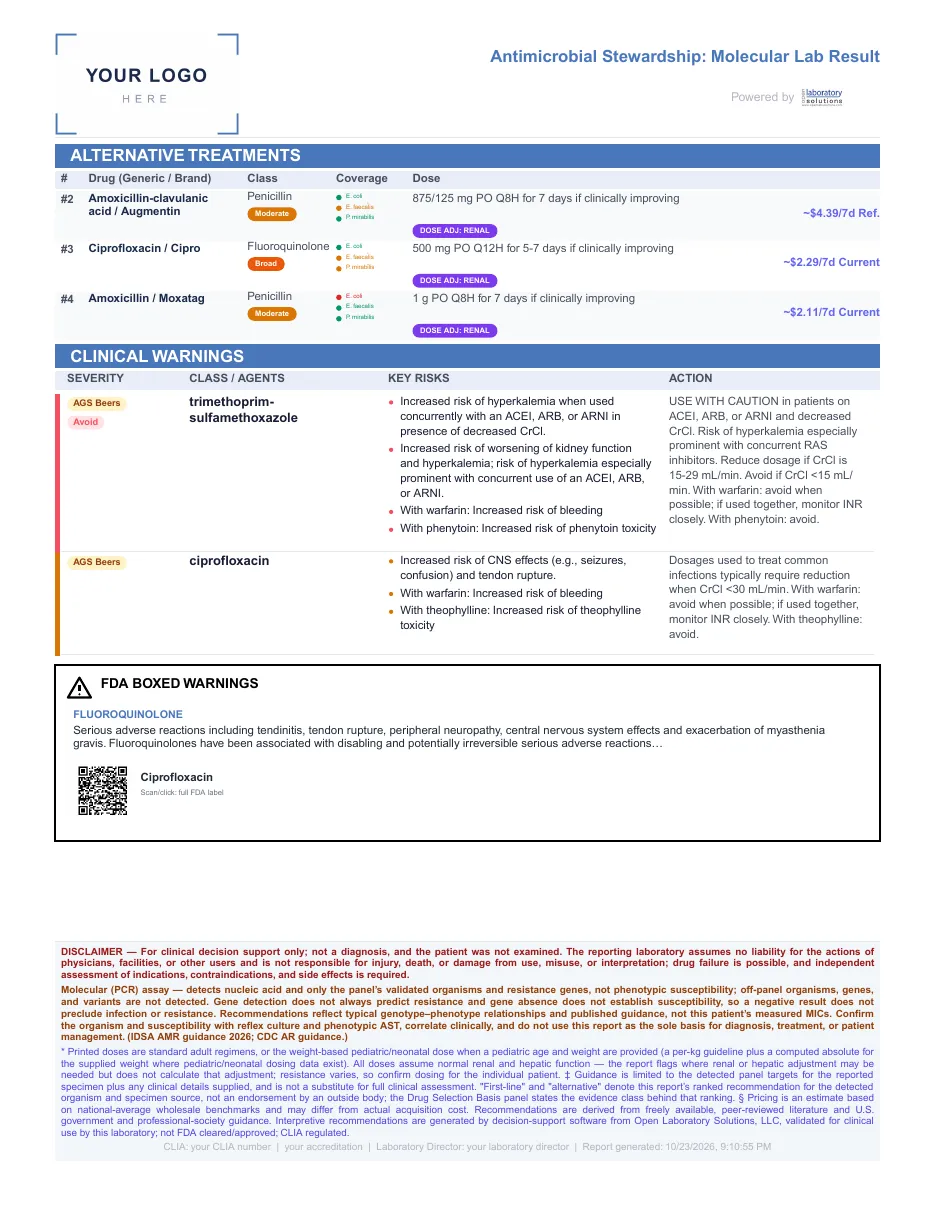
Page two: the alternatives, and the warnings, from the sample report

Page two: the alternatives, and the warnings

If the first choice will not suit this patient, the next ones are already worked out, and every caution carries an instruction.

Ranked alternatives
Second, third and fourth choice, each with generic and brand name, class, dose and duration.
Coverage for every option
Each alternative carries the same organism-by-organism coverage check as the lead recommendation.
Cautions chosen for this patient
Age- and condition-specific cautions selected for the person on this report, not printed for everyone.
Each one says what to do
A warning without an instruction is noise. Every row pairs the risk with the action: reduce, monitor, avoid.
Boxed warnings, and the label
The FDA's most serious warnings carried onto the report, with a scan code straight to the label.
Page three: the reasoning, written down, from the sample report

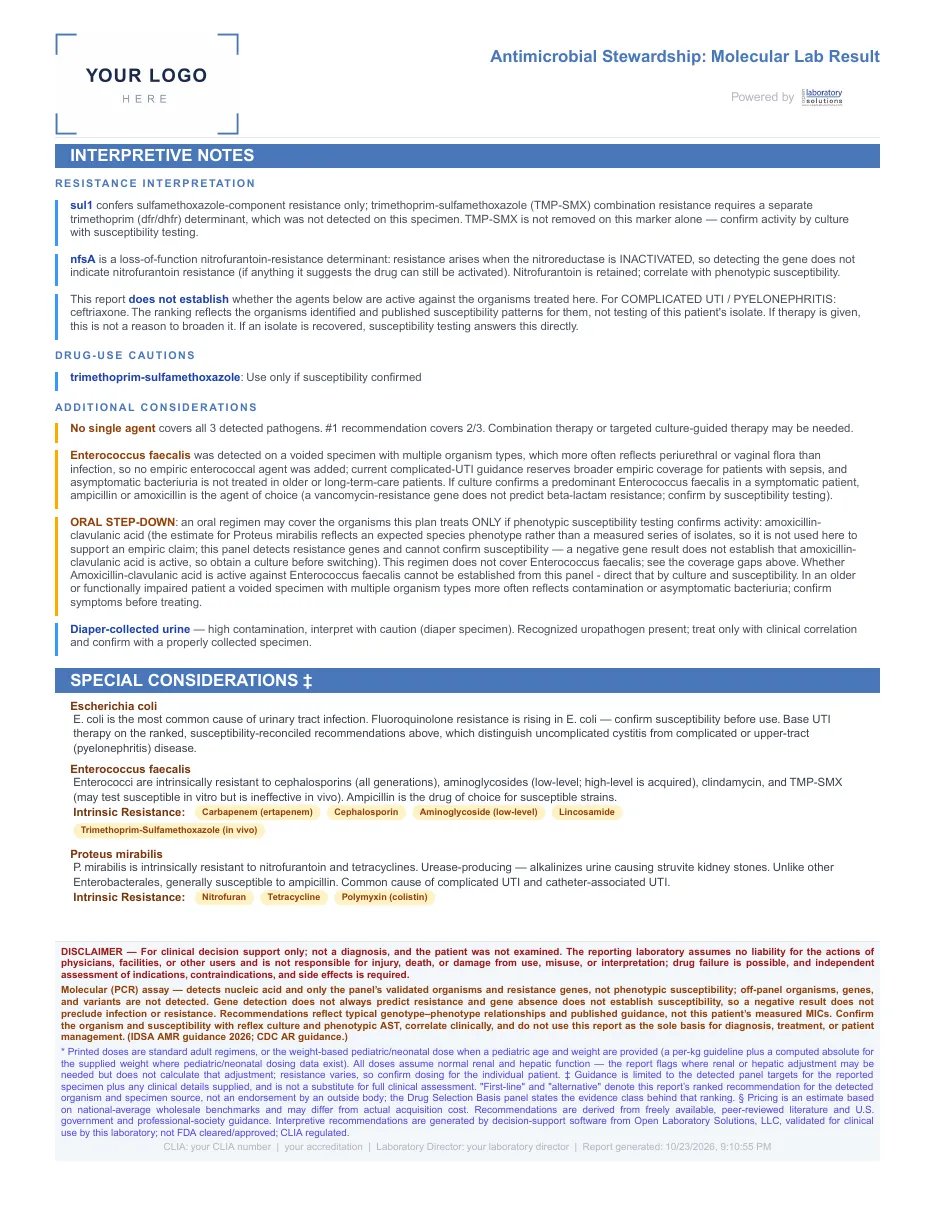
Page three: the reasoning, written down

What the detected genes do and do not mean, what this mix of organisms demands, and what the organisms themselves rule out.

What a detected gene really means
A detected marker is not automatically resistance. Where it changes nothing, the report keeps the drug and says why.
When one agent is not enough
No one agent is active against all three organisms. The report says which are covered, which are not, and what it would take to cover the rest.
Read in light of how it was collected
A diaper-collected specimen is contamination-prone, and the whole interpretation is framed that way.
Treat, or do not treat
Where a finding more likely reflects carriage than infection, the report says so, and names what would make it worth treating.
The step-down, worked out early
What an oral switch would and would not cover once culture returns.

Open the full report

Stewardship in the ranking

Right drug, right route, right duration

Three decisions that drive outcome and cost alike, and the three most often left unstated on a result report.

  1. 1

    Reserve agents stay in reserve

    The ranking leads with the agent that fits the presentation. Reserve drugs stay on the page, ranked lower, with the escalation trigger named.

    In the sample reportsA urine infection with an ESBL gene leads with ertapenem; meropenem is held for severe disease.

  2. 2

    Oral beats IV when it works

    Where an oral agent suits the site and the organism, the report says so and names it, so IV is not continued by default.

    In the sample reportsA wound with MSSA leads with oral dicloxacillin rather than an IV agent.

  3. 3

    A duration on every option

    Durations come from current guidelines or the FDA label, printed with the condition that changes them, so the course is stated on the report rather than left to look up.

    In the sample reportsComplicated UTI reads "7 days if clinically improving".

Safety

Six safety checks on every report

All six run automatically, on every report, and what they find is printed on the page. A report that offers a boxed-warning drug without printing the warning cannot be released.

  1. 1

    Allergy

    Drug names and whole classes, including shorthand like "sulfa". The culprit agent comes out of the recommendation, and the report names it.

  2. 2

    Boxed warnings

    Drugs that carry an FDA boxed warning are flagged. If one is offered to you, its warning is on the page.

  3. 3

    Interactions

    Taken from FDA labeling, with a check across every agent whenever the plan uses more than one.

  4. 4

    Age

    Weight-based pediatric and neonatal dosing, and geriatric cautions drawn from the AGS Beers Criteria.

  5. 5

    Pregnancy

    Agents contraindicated in pregnancy are removed; those with known fetal risk are ranked down and carry the caution with them.

  6. 6

    Organ function

    Renal and hepatic cautions wherever the label requires them, with the threshold named so the call stays yours.

Every recommendation traces to a source

No black box. Fixed rules from published research.

No AI model writes your report or chooses a treatment. Every recommendation follows fixed rules drawn from published research and guidance by clinicians and scientists, from FDA, CDC, NIH and IDSA, and every rule traces back to its source. The standards your clinicians already follow.

  • FDA drug labeling and adverse-event reporting
  • CDC antimicrobial-resistance surveillance
  • NIH / National Library of Medicine pathogen and drug databases
  • IDSA treatment guidelines

Ask us what changes, and when. We will show you, rule by rule, what moved and why, which is what your own validation will want to see.

Before it reaches you

Every report is cleared before it reaches you

Producing a report and releasing one are two different things. Anything flagged goes to a person before it goes to you.

  1. 1

    Generated

    The engine produces the report and runs its own safety checks over the finished document.

  2. 2

    Queued

    The finished report waits with us while the checks run over it.

  3. 3

    Screened

    A safety pass on the drug, the route and the duration of every option shown, within minutes.

  4. 4

    Flagged, resolved

    Anything flagged goes to a person, who corrects and re-runs it, or stops it. It reaches you only once it is right.

  5. 5

    Delivered

    Cleared reports go out to you. Anything unresolved stays with us until it is resolved.

Only a cleared report can be retrieved, by anyone, including an automated system. Several independent checks must all pass first. Clearance has to be positive: a missing result holds a report just as a failed one does.

How we charge

One accession. One charge. Ever.

Already paying a provider? Show us the rate and we will beat it.

Charged once per accession. Corrections and re-issues never add a second charge, and a true negative is not charged at all.

  • An edited report never bills twice. Corrections, amendments and resubmissions are all included.
  • Send negatives too. They cost nothing, you still get a branded report, and there is no filtering logic to maintain.
  • You only pay for positives, so the bill follows a number you can forecast.
What happensEffect on your bill
Report first released for an accessionCharged once
Report amended, content changedNo new charge
Report re-sent, content identicalNo charge
Report corrected and re-run during reviewNo charge
Re-released at any later dateStill the one original charge
No pathogen and no resistance gene detectedNo charge: a true negative

Your invoice shows, month by month, how many positive and negative reports there were and the one rate applied. A minute to check.

The case for switching

Your panel already found it.
This is the part that treats it.

  • Better decisions at the bedside

    A dosed, guideline-concordant plan on the result itself: narrower when narrower works, off IV sooner, with a real duration.

  • Safer by default

    Allergy, boxed warning, interaction, age, pregnancy and organ-function checks on every report. Incomplete data is confirmed with you, never guessed.

  • Evidence, not guesswork

    Hundreds of decision rules, each traced to published FDA, CDC, NIH and IDSA guidance written by clinicians and scientists. No AI model runs when your report is generated.

  • Checked before you see it

    Every report is screened on the finished document before release, and anything flagged is held until it is resolved.

  • Priced in your favor

    Edits and resubmissions never bill twice. Negatives cost nothing. One flat rate per positive report.

Take the six sample reports with you. Then put our rate beside what an edited report costs you today.